
Use this free UK redundancy pay calculator to work out your statutory redundancy pay from your age, years of service and weekly pay, using the rates from 6 April 2026.
Statutory redundancy · from 6 April 2026UK Redundancy Pay Calculator
This applies in England, Scotland and Wales from 6 April 2026, while Northern Ireland has its own cap.
Our free UK redundancy pay calculator works out the statutory redundancy pay your employer must pay you when you lose your job through redundancy. To begin with, enter your age and full years of service. Then add your weekly pay, and the calculator applies the legal rates and the £751 weekly cap that apply from 6 April 2026.
How the UK Redundancy Pay Calculator Works
Basically, statutory redundancy pay depends on three things: your age, how long you have worked for your employer and your weekly pay. According to GOV.UK, you then get a set number of weeks’ pay for each full year of service.
Firstly, half a week’s pay for each full year you were under 22.
Then one week’s pay for each full year in this age range.
Finally, one and a half weeks’ pay for each full year aged 41 or more.
The formula
Redundancy pay = Weeks’ pay × weekly pay (capped at £751)
Who Gets Statutory Redundancy Pay?
- Employees only: first of all, you must be an employee, not a worker or self-employed contractor.
- Two years’ service: in addition, you need at least 2 full years of continuous service with your employer.
- Genuine redundancy: similarly, your job must have ended because it is no longer needed, for example because the business closed or needs fewer people.
- No suitable alternative: finally, you can lose the right if you unreasonably turn down a suitable alternative job from your employer.
UK Redundancy Pay Calculator Examples
For example, here are three employees. In each case, they have at least 2 years of service.
She earns £600 a week, and since all 10 years were between ages 22 and 40, each counts as one week.
- Firstly: 10 years × 1 10 weeks
- Then: weekly pay £600
- Finally: 10 × £600 £6,000.00
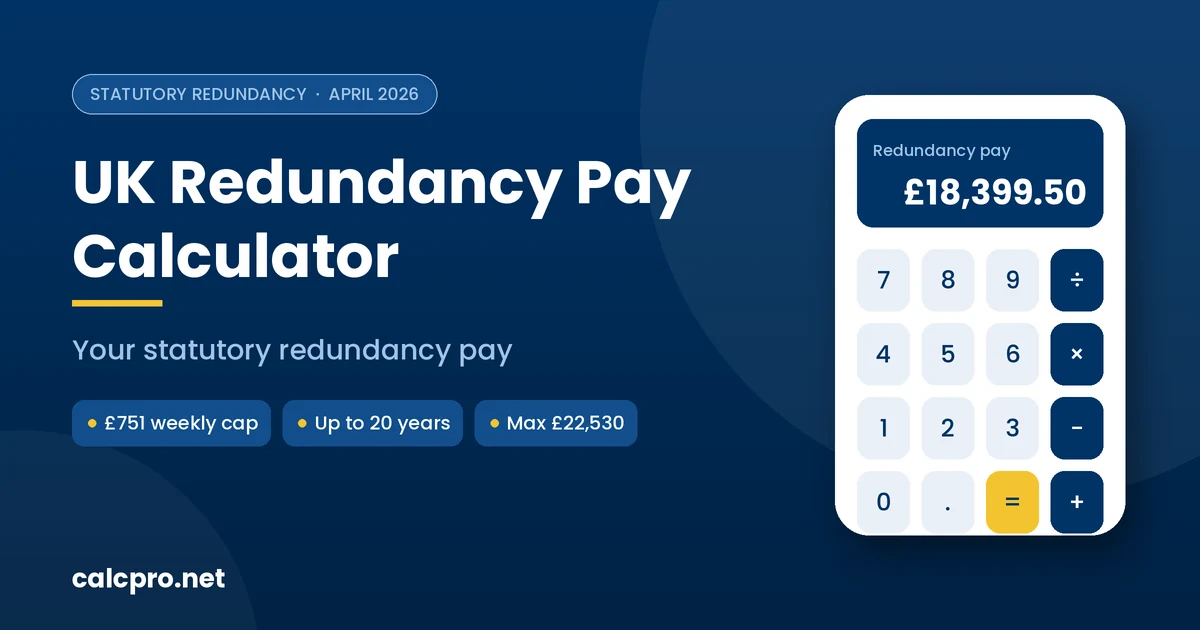
He earns £900 a week, but the cap limits it to £751. Also, 9 of his 20 years were at age 41 or over.
- Firstly: 9 × 1.5 + 11 × 1 24.5 weeks
- Then: capped pay £751
- Finally: 24.5 × £751 £18,399.50
In contrast, 3 of his 5 years were before age 22, so they count at half rate.
- Firstly: 3 × 0.5 + 2 × 1 3.5 weeks
- Then: weekly pay £450
- Finally: 3.5 × £450 £1,575.00
UK Redundancy Pay Table by Age
For example, this table shows how many weeks’ pay you get by age and years of service. Then, to find your redundancy pay, multiply the number by your weekly pay, up to £751.
| Age at redundancy | 2 years | 5 years | 10 years | 15 years | 20 years |
|---|---|---|---|---|---|
| 25 | 2 | 4 | – | – | – |
| 30 | 2 | 5 | 9 | – | – |
| 35 | 2 | 5 | 10 | 14 | – |
| 40 | 2 | 5 | 10 | 15 | 19 |
| 45 | 3 | 7 | 12 | 17 | 22 |
| 50 | 3 | 7.5 | 14.5 | 19.5 | 24.5 |
| 55 | 3 | 7.5 | 15 | 22 | 27 |
| 60 | 3 | 7.5 | 15 | 22.5 | 29.5 |
All figures are weeks’ pay. Also, a dash means that length of service is not possible at that age.
Is Redundancy Pay Taxed?
Statutory redundancy pay is normally tax-free, as long as your total redundancy payments are £30,000 or less. However, other money you receive when you leave is taxed as normal pay. For example, this includes your notice pay, holiday pay and any unpaid wages.
Enhanced Redundancy Pay
Statutory redundancy pay is only the legal minimum, so many employers offer more, often called enhanced or contractual redundancy pay. For instance, some pay a full month’s salary for each year of service, without the £751 cap. Therefore, check your contract, staff handbook or any redundancy policy.
Your Other Rights When Made Redundant
- Notice pay: you get at least one week’s notice for each year of service, up to 12 weeks.
- Holiday pay: in addition, you are paid for any holiday you have earned but not taken.
- Time off: also, with 2 years’ service, you can take reasonable paid time off to look for work.
- Consultation: finally, your employer must consult you before making you redundant.
How to Use the UK Redundancy Pay Calculator
- To begin with, enter your age on the date you are made redundant.
- After that, enter your full years of continuous service.
- Then enter your average weekly pay before tax.
- Finally, press Calculate Redundancy Pay to see your total and the breakdown.
More UK Pay Calculators
These tools also help when you leave a job. Also, browse all our financial calculators.
UK Redundancy Pay Calculator FAQs
How is redundancy pay calculated in the UK?
First of all, you get half a week’s pay for each full year you were under 22, one week’s pay for each year aged 22 to 40, and one and a half weeks’ pay for each year aged 41 or over. However, only your last 20 years count, and weekly pay is capped at £751.
What is the maximum statutory redundancy pay?
Since 6 April 2026, the maximum is £22,530. In other words, that is 30 weeks’ pay at the £751 cap, for someone aged 41 or over throughout 20 years of service.
Do I get redundancy pay with less than 2 years of service?
No. You need at least 2 full years of continuous service with your employer to qualify. Even so, you are still entitled to notice pay and any holiday pay you are owed.
Is redundancy pay tax-free?
Statutory redundancy pay is normally tax-free, as long as your total redundancy payments are £30,000 or less. However, notice pay and holiday pay are taxed like normal wages.
Does my notice period count towards my service?
Yes. Your service usually runs to the end of your statutory notice period, even if you are paid in lieu of notice. Therefore, it may push you into another full year of service.
What if my employer will not pay?
To begin with, write to your employer asking for payment. If they still refuse, you can claim at an employment tribunal within 6 months. On the other hand, if your employer is insolvent, apply to the Redundancy Payments Service.
Disclaimer: Overall, this calculator gives an estimate for general information only and is not legal advice. Also, rules differ in Northern Ireland. Moreover, for help with your situation, contact Acas or an employment adviser.