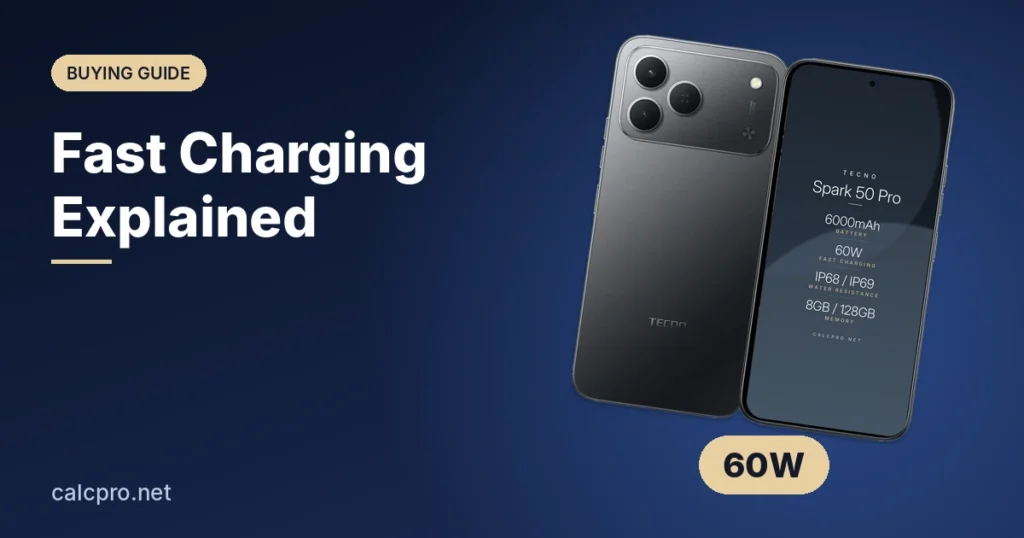
Fast charging explained in one line: more watts mean faster charging, but only if the phone and the charger both support that speed. Battery size matters too, because a bigger battery takes longer to fill. This guide compares 18W, 45W and 60W with real phones.
Because prices move often, we checked them on 2 November 2026
18W vs 45W vs 60W: Quick Comparison Table
First, here is what each speed means in daily use.
| Speed | What to expect | Example |
|---|---|---|
| 18W | Slow for large batteries, fine overnight | Tecno Spark 50 (7000 mAh) |
| 45W | About 50% in 23 minutes and full in about 43 minutes on the Camon 40 | Tecno Camon 40, Camon 50 |
| 60W | Fast top-ups even with a 6000 mAh battery | Tecno Spark 50 Pro |
Real charging time depends on the battery, the charger, the cable and the temperature.
Battery Size Changes the Result
A 7000 mAh battery at 18W takes far longer to fill than a 5200 mAh battery at 45W. Therefore, always read the battery size and the wattage together, not just one number.
For example, the Spark 50 lasts a very long time on one charge, but it needs a long session on the charger. In contrast, the Spark 50 Pro charges quickly, though its battery is a little smaller.
Do You Need the Right Charger?
Fast charging only works with a compatible charger and cable. If you plug a 60W phone into a 10W adapter, it will charge slowly. Also, check that the box includes the fast charger, because some brands sell it separately.
Is Fast Charging Bad for the Battery?
Modern phones manage heat and slow down as the battery fills, so fast charging is safe for normal use. Heat is the real enemy, so avoid charging under a pillow or in direct sun.
In addition, many phones include an optimised or protected charging mode that holds the battery near 80 percent overnight.
Charging Tips for Daily Use
Charge in a cool place and remove thick cases when the phone feels warm. Use short top-ups during the day instead of draining the battery to zero. Also, turn on the protected charging option if you charge overnight.
These small habits matter more than the wattage number in the long run. They keep the battery healthy for longer.
Real-World Charging Examples
On the Camon 40, a 45W charger takes the battery to about 50 percent in 23 minutes and to full in about 43 minutes. That means a short break can add many hours of use. The Spark 50, with its 7000 mAh battery and 18W charger, needs far longer for a full charge, but it also lasts much longer between charges.
So the real question is not only how fast the phone charges, but how often you must charge. A phone that lasts two days at 18W can need less charging time per week than a phone that lasts one day at 45W.
Which Charging Speed Should You Choose?
18W
Fine if you charge overnight and want the biggest battery.
45W
The best balance. It fills a battery quickly without extra cost.
60W
Best if you are always short of time and want a quick top-up.
Tips Before You Buy
- Check PTA approval. A PTA-approved phone works on every network, and our PTA tax calculator shows the tax on imported phones.
- Check the box. Confirm that the fast charger is included, so you do not buy one later.
- Think about wireless too. Some phones add wireless charging. Read our guide on wireless charging to see if it is worth it, and use our compare mobiles tool to compare phones.
Keep Reading
Fast Charging FAQs
Is 45W charging fast?
Yes, 45W is fast. On the Camon 40 it reaches about 50 percent in 23 minutes and a full charge in about 43 minutes, which is enough for most people.
Is 60W charging better than 45W?
It is faster, but the gain is small in daily life because phones slow down as the battery fills. The battery size also matters, so look at both numbers together.
Can I use a lower-watt charger?
Yes, but the phone will charge more slowly. It will not harm the phone, though it can take much longer to fill a large battery.
Does fast charging damage the battery?
Not in normal use, because phones control heat and current. Avoid hot places while charging, use a proper charger and turn on protected charging if your phone offers it.
Note: Because prices and stock change daily, treat the figures as estimates for general information. However, you can open each phone page above for full specs and the latest price.